

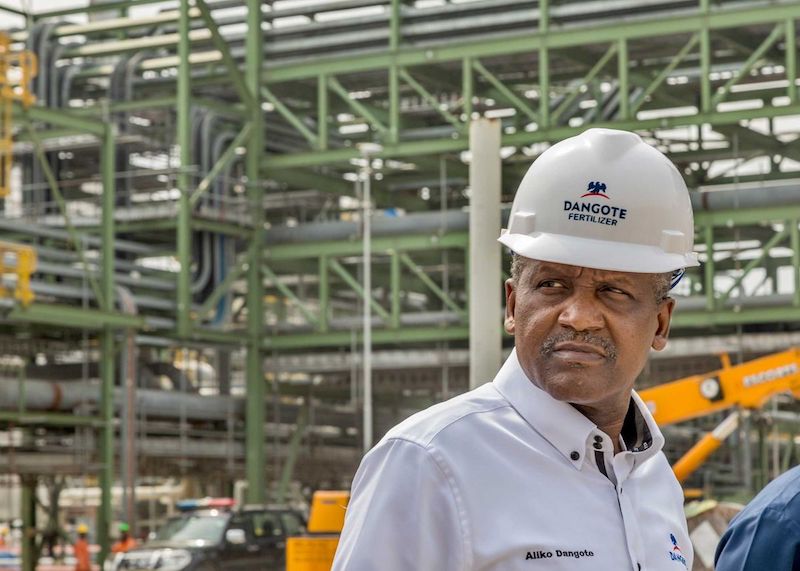
The news space in the past few months has been dominated by Dangote Refinery and oil marketers. It has been accusations and counter-accusations. The President/Chief Executive of Dangote Group, Alhaji Aliko Dangote, had lamented that “Cabals’ (indirectly referring to marketers) were fighting to sabotage his $20 billion refinery, adding that he was determined to win the fight. The marketers, on their part, stated that in as much as the refinery is considered a blessing to the downstream subsector and the economy at large, they are opposed to dominance and monopoly of the market by a single player, which supposedly is the route Dangote Refinery is gradually but firmly taking. EMEKA UGWUANYI critically delved into the matter and reports.
Before now operators of Nigeria’s downstream subsector of the petroleum industry canvassed for, believed and assured Nigerians that the deregulation of the downstream would solve the subsector’s problems, remove the bottlenecks in the procurement, marketing and distribution of premium motor spirit (PMS) or petrol. They also sermonized the benefits of deregulation, which included drop in prices of petroleum products particularly petrol due to market forces.
Besides, they strongly believed that the coming into operation of Dangote Refinery would bring enormous relief to the subsector and further push down prices of white products considering some costs savings as a result of in-country refining. However, two years into deregulation of the downstream and eight months into petrol production from Dangote Refinery, it has been a rough road for marketers with many of them out of business.
What went wrong? What is the remedy and what should be done to create healthy competitive environment and a level playing field for all players? In this report, these and many others are the important questions addressed by the key stakeholders in the downstream.
The marketers including the Major Energies Marketers Association of Nigeria (MEMAN), represented by the Association’s Executive Secretary, Mr. Clement Isong; Depot and Petroleum Products Marketers Association of Nigeria (DAPPMAN), represented by the Association’s Executive Secretary, Mr. Olufemi Adebayo Adewole; Petroleum Products Retail Outlets Owners Association of Nigeria (PETROAN), represented by the Association’s President, Mr. Billy Gillis Harry and Independent Petroleum Marketers Association of Nigeria (IPMAN), represented by the Association’s National Publicity Secretary, Chief Chinedu Ukadike, shared their perspectives.
What they said
For the marketers, nothing has gone wrong. “Price deregulation is a reform process and was always going to be a painful process. In essence, we were borrowing to spend on consumption, money we did not have which was leading us to bankruptcy and we now have stopped spending that money on that subsidy so we are going through an adaptation process of living within our means and all things being equal, we will not return to our past bad habits, said Adewole.

“The challenge is that we had gotten so used to this bad behaviour that adjusting is hard! Also, much of our infrastructure had gone into acute disrepair, (refineries, pipelines, trunk roads for deliveries, marine reception facilities like Atlas cove) that rebuilding the infrastructure will take time. Indeed and worse still, rebuilding the workflow processes, competences and integrity of the Human Resources along the entire supply chain will remain our biggest challenge for a long time to come!
“So deep has been the rot!
“There were no other options left and market efficiency is the best driver encouraging the investment in men and infrastructure to take us to optimal efficiency, but it will take time. Having said that, prices did go up and have gone back down as predicted albeit due to extraneous circumstances. It will, however, never go back down to previous levels due to the second parallel reform of the consolidation of the exchange rate. Still, we are heading in the right direction and these necessary reforms will take us to the promised land if we stay the course,” Adewole added.
For MEMAN, “prior to deregulation, marketers and proponents had argued that Government control (e.g. subsidies, fixed pricing) distorted the true cost of petrol and that If government stepped back and allowed competition (i.e. deregulate the downstream sector), many players would compete, leading to better supply, efficiency, and ultimately lower prices over time. However, almost two years after commencement of the deregulation policy, petrol prices haven’t fallen significantly and in fact, they have remained comparatively high due to the following reasons:

“*Limited Competition: True competition in all segments of the value chain requires many strong players in the various segments but this is not the case presently at the refining end though it exists, and it is vibrant in the storage and retailing segments of the value chain. There must be real competition at the refining segment with opportunities for marketers to receive their stocks from more than one refinery unlike one dominant refinery dictating ex-depot and retailing prices through alliances with few and select marketers to the detriment of other players in the industry.
“*Foreign Exchange Issues / Global Oil Market Instability: The price of crude oil in the world market which is denominated in the United States dollar (US$), is the basic determinant of Nigeria’s local fuel prices as all refineries will either source their feedstock in US$ or its Naira equivalent. Unfortunately, a volatile or expensive exchange rate directly pushes up local petrol costs. Deregulation didn’t solve Nigeria’s forex scarcity. In addition, world crude oil prices have been volatile due to geopolitical tensions such as the war between Russia and Ukraine; the unease in the Middle East, etc. The downstream sector regulator was recently quoted as disclosing that the Dangote Refinery and the supplement from the NNPCL refineries production capacity was 33.5 million litres while the total local consumption was 40.6 million litres, slightly below the Federal Government’s benchmark volume of 50 million litres. The shortfall was bridged via imports and high global prices mean the imported refined products will be expensive, no matter the local deregulation.
“*Inflation and Economic Conditions: General inflation, weak consumer purchasing power, and broader economic challenges such as banditry and Boko Haram insurgency, affect transport costs, storage, and operations and all of these contribute to higher final prices at the filling stations,” Clement Isong said.

The National President of the Petroleum Products Retail Outlet Owners Association of Nigeria, Billy Gillis-Harry, also confirmed that the sector is undergoing transition to align with the new order coupled with existent challenges that built up in the old order. According to him, infrastructural deficit including bad roads, foreign exchange issue and poor refining climate that characterized the old order culminated in what the sector is currently suffering. He, however, expressed optimism that everything will fall into place with time, good policies and proper regulations.
IPMAN also shared the same view with its sister associations. The National Publicity Secretary, Chief Chinedu Ukadike, said: “To have a level playing field for all stakeholders, we should be talking about enabling laws, infrastructure, security, exchange rate, access to funds, distribution channels, production of crude oil, factors that affect distribution channels, among others as well as distribution of these products and alternatives to regular use of PMS and other related products.

“When the PIA was passed into law, it provided the liberalization of the market, free economy . The factors enumerated are the factors in the front burner of the liberalization of the market. Nigerian oil refineries should be made to start working, adequate supply of crude oil to the refineries that are operating, and security provided for these refineries, among others.
“When Dangote Refinery came on board, he was faced with challenges of procuring crude oil for his 650,000 barrels per day refinery; It was very difficult for him to get this crude oil and at a point he resorted to import from America to refine in Nigeria, why then are we an oil producing country. Other refineries such Edo Refinery, Waltersmith Refinery, Aradel Refinery and Niger Delta Refinery, among others, have problems of accessing crude oil. Most of them use trucks to bring crude oil to their refineries. This becomes really worrisome that they also find it very difficult to access forex to buy crude oil for these refineries. They complained to government and government listened and started selling crude oil to them in Naira to be able to bring down the price of products as a member of oil producing nations. So, government’s policies, actions and inactions contribute to the price of petroleum products and how conducive the operating environment should be.”
Analyst standpoint
On conducive operating environment and healthy competition that is free of anticompetitive practices, basic economics teachings showed that competition fuels fairness, lowers prices for consumers, ensures higher quality products and services and most of all creates greater innovation among players. It also offers multiple choices for consumers and greater efficiency in operations. But to unlock these benefits, there must be genuine fairness and close regulatory watch and monitoring, otherwise the big or bigger players would crowd out those with less or shallow pockets. This particular scenario is the primary concern being shared by the marketers. All they want is healthy competition that allows all categories of players to play and compete in their specific areas to keep the value chain unbroken.
Therefore, the extended conflict between the marketers and Dangote Refinery over fears of market dominance is well founded, said Mfei Alol-Nugo, an analyst. According to him, the labeling of marketers as cabals by the President/Chief Executive of Dangote Group, Alhaji Aliko Dangote, is diversionary and must be closely watched.
Mfei Alol-Nugo in his report entitled “The illusions of a cabal in the mindset of an entrepreneur,” highlighted declaration made by Alhaji Aliko Dangote that he would “defeat the cabal” in Nigeria’s oil sector as misleading and a strategic diversion from the pressing issues facing the nation’s energy landscape. To him, it is a diversionary move from Dangote’s monopolistic embrace, which the billionaire businessman had applied in the Nigerian cement and food sectors.

Mfei Alol-Nugo noted that the random price cuts of petrol by Dangote Refinery were not borne out of patriotism but a strategic step to take control of the market. He noted that it was unfair to label marketers, depot operators, logistics providers, and fuel station owners as “cabals,” forgetting the decades of sacrifice, resilience and investment these players made to keep the subsector and Nigeria’s economy running when government refineries collapsed and NNPC vessels sat idle at sea.
To labeling them cabals is akin to giving a dog a bad name to hang it. He noted, therefore, positioning the Dangote Refinery as a solution to Nigeria’s refining challenges is only but a step to monopolistic and domineering control of the market space. He stated that the danger in accepting the narrative that the refinery is the sole “solution to Nigeria’s refining challenges” would lead to stifling competition and leaving the nation vulnerable to supply disruptions. “Let us not confuse scale with benevolence, he added. The Dangote Refinery, boasting a 650,000 barrel-per-day capacity, may be the largest in Africa, but its emergence has ushered in something far more dangerous than inefficiency and it is called monopoly under the guise of national interest,” he said.
He further explained that “Dangote Refinery’s preference to restricting off takers to ex-gantry loading operations in contrast to marine coastal vessel loadings for private depots is a move towards monopolistic dominance of the market.
“The refinery had consistently released prices which put landing cost of its products, ‘into-tank’ for private depots, at a disadvantage in contrast to ‘ex-gantry loading’ price. This disadvantage is the main reason adduced by marketers who opted for PMS imports as the cost ‘into-tank’, shipping expenses inclusive, were lower and more beneficial to the buying publics than Dangote Refinery’s coastal cargo (shipping expenses included) prices.”
Mfei Alol-Nugo also reported some of the benefits Dangote Refinery enjoys, which are part of the reasons it ought not muscle other players out. According to him, “Dangote Refinery’s operations have been bolstered by substantial crude oil allocations from the Nigerian National Petroleum Company Limited (NNPCL), totalling over 84 million barrels since its inception. While supporting local refining is commendable, the preferential treatment and exclusive agreements raise questions about fairness and transparency in the allocation process.
“Dangote’s receipt of first choice or priority volumes of Nigeria’s Bonny Light and other high-grade crude at stable naira prices, regardless of fluctuations in the international market grants the refinery a vast advantage, a pricing edge, over smaller local refiners or modular plants even if these also qualify for the same naira for crude oil policy.

Photo caption: Trucks loading at the gantry of Dangote Refinery
“Dangote may price refined products based on international benchmarks (e.g. Platts prices) rather than cost-reflective naira inputs, despite paying for crude oil in naira.
“This allows the refinery supernormal profit margins, as crude oil is cheaper in naira, but fuel is sold at prices benchmarked to United States Dollar (USD). Consumers pay international prices while Dangote enjoys local cost structures but nay it is the ‘cabal’ that he focuses on.”
Besides these benefits, Dangote Refinery uses random price reduction to cause undue losses to the marketers. He said that several marketers experienced a situation of paying for product today at a higher price and Dangote Refinery slashes the price of the same product the following day while the initial buyer, a marketer, a private depot or even a retailer, is stuck with expensive stock that will be hard to sell without making a loss. This impacts negatively on the marketer and discourages stocking of large quantities fearing sudden price drops, he added.
Lending credence to Mfei Alol-Nugo report, Dangote Refinery had filed a suit at the Federal High Court in Abuja on September 6, 2024 against the Nigerian Midstream and Downstream Petroleum Regulatory Authority (NMDPRA) and several oil marketing companies including NNPC Ltd., Matrix Energy, AYM Shafa, AA Rano, T. Time Petroleum Limited, among others.
In the suit with Suit No FHC/ABJ/CS/1324/2024 entitled “Dangote Refinery vs NMDPRA & others,” Dangote Refinery challenged the defendants and claimed it had the capacity to produce enough gasoline (PMS) and other refined products to satisfy Nigeria’s consumption needs, therefore, the court should stop NMDPRA from issuing import licences for importation of refined products. Dangote claimed that NMDPRA had continued issuing import licences to NNPC Ltd and other marketing companies despite its capacity to meet local PMS demand. The Refinery hinged its claim on the provisions of the Petroleum Industry Act (PIA) citing Sections 317(8) & (9), which provided that “Imports are allowed only if there’s shortfall.” Therefore, Dangote Refinery sought cancellation of the import licences as further imports were unnecessary and potentially harmful to the $20 billion asset and it also sought additional ₦100 billion damages for economic losses incurred by the Refinery.
Additional reliefs sought by Dangote Refinery in the suit included an order directing the NMDPRA to seal off all facilities used by the defendants for storing imported refined petroleum products. It also claimed that as a registered free-zone enterprise, Dangote is exempt from all federal, state, and local government taxes, levies, and rates, a declaration that imposing additional levies on Dangote is contrary to various legislative Acts, as well as an order directing the NMDPRA to withdraw all import licences issued to the defendants.
The Plaintiff had alleged that NMDPRA had threatened to impose a 0.5% levy on Dangote’s wholesale transactions, which contravened statutory provisions that restrict such levies on transactions within free zones, arguing that the establishment of free zones aims to encourage competition and attract foreign investment.

However, in a surprising twist, Dangote Refinery eventually chose to withdraw the suit against NMDPRA and others citing the intervention of President Bola Ahmed Tinubu, which led to all the parties involved in the suit to have conciliatory talks.
Corroborating Mfei Alol-Nugo, the marketers agreed that what Dangote Refinery aims to achieve is total dominance of the downstream market, which according to them is inimical to the subsector and the economy. When asked whether Dangote Refinery doesn’t incur losses through such random reduction of PMS price as it might be doing that in compliance with market forces, the marketers said he might be incurring losses too but explained that the random reduction in price of his petrol is a market strategy.
According to the marketers, their concern is that there is a probable attempt by Dangote Refinery to replicate in Nigeria’s downstream the Mukesh Ambani experience in India. Mukesh Ambani is the owner of a telecom giant that reportedly came into the Indian telecom sector with a simple rule, he crashed the tariff abysmally, lost $25 billion over a period of 180 days. He took over the market, when he knew that many of his competitors had crashed out and those remaining were helpless, he set the price and gained $75 billion over a period of 90 days. “So, that could be a strategy, the marketers said. It is a loss strategy in market share acquisition. Today Mukesh is a leading telecom giant in India because it applied that principle and we just hope that this is not the same experience that is being targeted by some of our refiners in Nigeria to make those investment losses and then set prices when Nigerian public becomes absolutely dependent on its output.
“Whether it is Dangote or any other refiner or importer that has that kind of motive, it has to be limited and that is the reason we call on Nigerian Midstream and Downstream Petroleum Regulatory Authority (NMDPRA) and Federal Competition and Consumer Protection Commission (FCCPC) to swing into action at all times in this area because this is a very critical inbuilt to the growth and stability of the economy.
“PMS has become a very important element in the economic growth of Nigeria. So, we need to be very conscious and intentional about it and make sure there are no price touting gap, no tendencies for monopoly that will be disruptive, and ensure that every segment of the industry is inclusive in the value chain and by this, we mean the refiners refine, storage owners store, logistics companies do their transportation, retailers, and retail outlets owners sell quality products that are affordable and pocket-friendly. This is how we can grow the economy.”
According to Wikipedia, Mukesh Dhirubhai Ambani is an Indian billionaire businessman. He is the Chairman and Managing Director of Reliance Industries, owners of the giant telecom company in India called Reliance Jio Infocomm Limited. As of May 2025, he was the richest person in Asia and the 13th richest in the world with a net worth of $108 billion. Mukesh Ambani sometimes is characterized as a plutocrat. He has attracted both fame and notoriety for reports of market manipulation, political corruption, cronyism and exploitation, the Wikipedia wrote.
Marketers Position
The marketers agreed that Dangote has the resources and deep pockets to efficiently play in all segments of the downstream sector value chain but as observed by Mfei Alol-Nugo, these marketers made huge investment to keep the subsector and Nigeria’s economy running before the advent of Dangote Refinery, and many of them still owe the banks huge debts as a result of loans taken to make those investments. So, it will be inhuman and sheer anti-competitive practice to force them out of business in one fell swoop.
The marketers said even though all the players in the downstream subsector are in business to make profits, the profits should have a human face, and businesses practised with discipline, and followed through with the extant laws of Petroleum Industry Act (PIA). This law provides for a level playing field by itself. It encourages in-country refining, production of energy of any sort. This is what we expect and should encourage because oil businesses are very capital intensive, therefore, there is a need for everyone playing in the field to carry the other parties along. For instance, let the refiners refine, let depot owners store, and the logistics companies do their own whether marine or by trucks or tankers and let the marketers do their work and let the retailers retail efficiently. This is the full value chain of the downstream sector, and all that is required for everything to be stable is knowledge and understanding of the operating environment and the rules that will give us the value to operate efficiently. In other words, there should be division of labour.
“The road that will give us value to operate efficiently, the powers of demand and powers of supply and all of those efforts that should be able to ensure that inputs costs are affordable and products that are coming out are also affordable. That’s a generic method of getting a stable action for getting everybody on board,” they added.
Is Dangote Refinery Beneficial or Not?
The marketers entirely agreed that Dangote Refinery is beneficial to the downstream sector and the economy but are averse to its operational system targeted at monopolizing the entire market space.
To the Executive Secretary, Depot and Petroleum Products Marketers Association of Nigeria (DAPPMAN), Mr. Olufemi Adebayo Adewole, “Of course all local refining is a blessing to Nigeria and its economy and to all players, operators and consumers alike. We must all simply find the best way of living with and enjoying its benefits and encouraging it to grow (expand) to arrive at its full potential and optimal efficiency while avoiding any potential negative or harmful market impacts.
“I support all local or domestic refining. I look forward to Nigeria having multiple refineries and becoming the refining hub of Africa. I also believe in a free competitive market as the key to unlocking Nigeria’s potential of becoming an economic giant. If you believe in potential of the Nigeria, its location, its geography, its natural resources, its population, cultural heritage and practices which gives Nigerians a certain quality of enterprise, boldness and willingness to step up and compete and win, then you need to bet on it like Ronald Reagan bet on his USA.
“In which case, the Nigerian State and Nigerians must do what is pragmatic to support the collective interest of Nigerians!”
For the Executive Secretary of Major Energies Marketers Association of Nigeria (MEMAN) Mr. Clement Isong: “The $20 billion, 650,000 barrels per day capacity Dangote Refinery officially started producing diesel and aviation fuel in early 2024 and commenced PMS production around September 2024. The NMDPRA, through its Chief Executive, recently disclosed that the refinery’s current production level is insufficient to meet the nation’s consumption estimates hence the Authority gave out import permits to deserving marketers to import petrol to bridge the shortfall.
At the inception of its AGO sales and due to its cheaper prices, which was lower than the imported stock, Dangote Refinery helped stabilise local supply and reduced forex pressures. The same, however, could not be said for PMS sales as many marketers did not have direct sales contracts or easy access to lift products due to the refinery’s sales policy and some marketers’ inadequate financial muzzle. Only bigger, better-financed firms were able to negotiate good supply deals. All patrons of the refinery were hard hit and suffered financial losses when the refinery suddenly and without notice, reduced its product prices several times within a time frame.
“The refinery’s pricing policy which put many marketers at a disadvantage and the opportunity, as enshrined in the PIA 2021, that allows marketers to import the shortfall, encouraged many marketers to opt for PMS imports, with competitive lower landing cost and by extension, retail price. This was, however, viewed as ‘unfair advantage’ by the refinery’s management with the resultant series of price slashes, ostensibly to undercut import competition. The Nigerian buying public is, however, better off as the price war simply made the prices of diesel and petrol cheaper than it ordinarily would have been,” he added.”
“We would say that Dangote Refinery is a very useful addition to the downstream operating space and we are very proud of that refinery,” said Billy Gillis Harry, President of PETROAN. “But being proud of its establishment, we should also know and see how the business model should be able to encourage the growth of every player in the industry. As of today, we cannot say that is the case because we don’t want to see prices jumping up and down without deliberation. So far we are just seeing prices jumping up and down and cannot explain what those price changes are all about. We think that there should be a method to check those kinds of actions. Even though we are in a fully deregulated segment of the industry, there are many things that are needed to be done to make sure that deregulation is efficient. We probably need to get back to the drawing board and review certain things and get them in proper order,” he added.
On Random Slashing of Petrol Price by Dangote Refinery
The marketers shared the pains they go through as a result of random petrol price cut by Dangote Refinery. For DAPPMAN, the slashing of petrol prices is quite often painful to marketers and petrol station dealers and many have made losses, it is true. Actually, extreme market volatility is not prescribed in any economy and is often at the root of intervention by country administrations. Sudden and consistent volatility is bad for all operators and consumers (businesses and individuals alike) who are unable to plan their expenditure. Having said that, the dropping of prices is a feature of the market and we cannot ask for a free competitive market and be against prices dropping as a result of innovation, investment, or other market strategy. I guess the answer is somewhere in between…managing extreme volatility while allowing innovators and investors benefit from their risks taking, enabling them to reduce prices. The regulator has the immediate role of protecting the market for the benefit of consumers and we must trust them!
MEMAN also corroborated DAPPMAN, it said: “Yes, Dangote slashing petrol prices can be good for marketers and the buying public. When a major local refinery like Dangote cuts prices frequently, ideally, it should bring some advantages for petroleum marketers in terms of a lower landing cost for marketers who will buy petrol cheaper and they in turn, would extend the price reduction to their customers at the retail end.
‘A stable retail pump price, in the event of a drop in the wholesale purchase price, will translate to better profit margin for the marketers. Cheaper petrol allows marketers to run competitive promotions, loyalty schemes, or discounts to attract more customers.
“We must at this juncture note Dangote Refinery’s preference for ex-gantry loading sales in contrast to marine coastal vessel loadings for private depots. Dangote Refinery had consistently released prices which put landing cost ‘into-tank’ for private depots at a disadvantage to ‘ex-gantry loading’ price. This is the main reason adduced by marketers who opted for PMS imports as the cost ‘into-tank’, shipping expenses inclusive, were lower than Dangote Refinery’s coastal cargo (shipping expenses included) prices.
“If a marketer buys petrol today at a higher price and Dangote slashes prices tomorrow, the marketer is stuck with expensive stock that will be hard to sell without making a loss. This impacts negatively on the marketer and discourages stocking of large quantities fearing sudden price drops. But for the import option as enshrined in PIA 2021, this could have created supply disruptions at retail outlets.
“A dominant Dangote Refinery will give marketers very little bargaining power. Marketers will price-takers, fully at the mercy of Dangote’s pricing and sales strategy which, in the long term, with regular price cuts, will erode the working capital of many smaller players who can’t absorb price shocks. This reduces competition and ironically makes the market less healthy
For PETROAN, we believe marketers who said that random reduction of petrol price by Dangote Refinery affect them negatively even as they see it as a step to taking absolute control of the market, which spells doom for the industry. The marketers said if that strategy continues for a long time unchecked, it will make them lose interest in import and will be wholly dependent on Dangote Refinery, which by extension makes him have monopoly of the downstream.
“I will not disagree with them, said the PETROAN President. I would rather add that for us in PETROAN we are bleeding badly because when we buy products and the products have not gotten to our retail outlets, maybe because of distance in transportation, prices change upwards or downwards, that certainly spells a doom for the ability to restock or even to be in business and may cause scarcity across specific stations, specific zones or areas and that will impact negatively on Nigerian economy.
“At that point those who have petroleum products will start fixing prices in thousands for their products and that is what we should avoid and that is why we are calling on NMDPRA to deepen their regulatory oversight and make sure the rules are properly applied and no one individual company by any description takes undue advantage of the Nigerian public.”
IPMAN National Publicity Secretary, Chief Chinedu Ukadike, however, had a contrary view. He said the random reduction of fuel price by Dangote is good, noting that even if marketers incur losses, it is still part of the transition. He noted that Dangote as a refiner should align with changes of crude price in the international market. He stated that because some marketers were used to profiteering, they are finding difficult to adjust to the current reality.
He noted that the downstream has been liberalized, therefore, the market is open to forces of supply and demand. To him, members of IPMAN now access products at cheaper price and even sell cheaper than NNPCL outlets, which hitherto was unthinkable.
Fuel importation
The marketers took a consensus stand on fuel importation. To them, fuel importation is a window that should be kept open at all times to act as a stop gap or bridge in case of emergencies. Therefore, seeking permission to stop importation of fuel by any refiner might be counterproductive to the wellbeing of the sector and the economy.
To the Executive Secretary, Depot and Petroleum Products Marketers Association of Nigeria (DAPPMAN), Mr. Olufemi Adebayo Adewole, “some importations are necessary today to meet our consumption needs. During this period we should push up our refining capacity to bring economies of scale and price competitiveness to our local production (crude and refined products) and distribution efficiency. Once that is achieved, who cares if importation is allowed or not? We too want to export to other countries so we allow free flow of products, crude or refined in and out of the country and allow the numbers, the market and its economics to define what best suits or benefits our country, its businesses and its consumers at every point in time. Again, we need to trust the regulator to keep its finger on the pulse and regularly publish figures showing us that we are headed in the right direction.
“At all times importation has always been an option, an option because it provides an immediate succour whenever there are challenges in the in-country refining. We should have in-country refining and also have importation that should be done on need basis. We support that imports should be part of the energy mix, energy source to ensure that we have consistent supply of petroleum products to guarantee our energy security, said PETROAN boss, Billy Gillis Harry.
For the Executive Secretary, MEMAN, Mr. Clement Isong, “Fuel import option to bridge shortfalls in local refining production capacity is already enshrined in the PIA 2021 because, in the wisdom of the legislature that crafted the bill, and as recently disclosed by the Chief Executive of the NMDPRA, Engr. Farouk Ahmed, Nigeria does not yet have enough domestic refining capacity fully operational to meet local petrol demand consistently.
“The Dangote Refinery, the existing government-owned refineries (Port Harcourt, Warri, Kaduna) and all functioning modular refineries, presently cannot meet up with both the actual volume consumed: 44.6 million litres or the benchmark buffer volume of 50 million litres. And according to the NMDPRA Chief Executive, without imports, petrol shortages would occur, leading to scarcity, long queues, black markets, and price spikes that would cripple the economy hence a controlled and smart importation is necessary to bridge the gap until local production becomes steady and sufficient. Such import licences are being managed transparently, fairly, and competitively as enshrined in the PIA 2021 and according to the energy requirements of the nation
For Ukadike, importation of fuel should always be open for intervention at critical periods. I have always said that we are opposed to banning importation of fuel until the period we as a country attain unquestionable production sufficiency. So, fuel import will continue to be part of energy mix until that period.
Expectations from Government and Regulators
The marketers said that the regulators must be trusted, respected and supported by all players to do the job they have been given. That is the only way to avoid chaos and the law of the jungle with all the negatives non-adherence to the rule of law engenders.
For deregulation to work and deliver stable prices and a level playing field, all stakeholders, government, the regulators and the private sector operators, have critical roles to play.
Government, via its policies, actions and pronouncements and through the regulators must create a transparent and competitive regulatory environment. The Nigerian Midstream and Downstream Petroleum Regulatory Authority (NMDPRA) must ensure, level playing field, open competition, prevent monopolistic practices, and sanction collusion. Pricing information, import licenses, and depot access should be transparent.
Optimal support must be given for the establishment of more modular refineries and help existing big refineries, like Dangote, Port Harcourt, Warri, etc, to operate efficiently to increase local refining capacity thereby reducing forex pressure, stabilize prices while enhancing competition.
Wherever and whenever foreign exchange is required by any player, it is necessary to guarantee access to forex at market-reflective rates as shortfalls in refined volumes, to local consumption capacity, would be imported. Marketers need fair, predictable access to dollars, without favouring a few big players. A stable forex market levels the playing field for both small and large marketers.
Invest in Infrastructure and Promote Efficiency: By all means, repairs/upgrades to pipelines, jetties, passageway channels for marine cargoes, storage depots, and road networks will enhance the efficiency of the downstream petroleum sector. If the mode and means of transporting petrol becomes cheaper and faster, it reduces overall market costs. Efficient storage and distribution networks reduce costs, limit wastage, and make their supply chains stronger while allowing them to price more competitively. For efficiency, marketers with inadequate financial muzzle can form consortiums for joint procurement from local refineries or joint fuel imports at better terms rather than for each of them to struggle individually. This would democratize access.
Strengthen Consumer Protection and Avoid “Backdoor” Price Setting: The Federal Competition and Consumer Protection Commission (FCCPC), alongside the NMDPRA, must set up mechanisms for customers to report abuse, hoarding, or price gouging. Both organs must enforce penalties, as enshrined in the ‘PIA 2021’ for malpractice, to build trust in the system. All stakeholders must allow market forces, supply, demand and efficiency to determine pricing.
Creation of a better pump service experience through customer loyalty programmes, open display of pump prices for comparison and other innovations that can differentiate individual brands allow competition to thrive and flourish.
Also, one of the things we would like to see addressed by government is that we have a Port Harcourt Refinery that is supposed to produce 210,000 barrels per day of crude and we want to see that refinery completed and that is one request by PETROAN. That refinery should be completed and the government and NNPC should come up with an effective timeline that must be obeyed and not a political statement but actual economic directed policy that should bring up all those refineries into active status. The Warri and Kaduna Refineries should be tackled and what does this mean? This means that in-country capacity production will be high and the retail outlets owners, who are the last mile in the industry, would be able to buy products from every source. We want the Dangote and NNPCL refineries and every other modular refinery that doesn’t produce PMS to be working to ensure there is adequate products in-country. This is the most critical aspect of it and government’s role is to ensure rules are made to give these operators a soft landing for all operations.
Crude oil should also be made available to the refiners and we should see a special production value that should be able to guarantee two million barrels per day for in-country refining alone. That is when Nigeria should become a centre for hydrocarbon refining and become the export hub for refined products to Africa and even beyond.
Currently, we are not doing up to two million barrels so we should try to produce up to four million barrels per day and will require a lot of engineering, economic reengineering, good relations with host communities from the Niger Delta especially and also ensure that communities see themselves as co-owners of the resources and part of the values of the economy, this will help to stabilising the industry.
Impacts of competitive and anticompetitive practices on the downstream sector – Experts
Experts enumerated the benefits of competitive behaviours and practices. To them in an environment where there are healthy competition and practices, numerous active players are encouraged to come in and participate in the market. Competition drives higher quality products and services, creates more innovations and choices for consumers as well as greater efficiency in operation, they added. Besides, it ensures ease of entry and exit for businesses and regulatory neutrality – no bias toward any player from the regulators. The experts noted that competition enthrones transparent pricing and good market practices.
For the consumers, healthy competition ensures lower and fairer prices at the pump, improved service delivery at filling stations, product innovation and transparency and promotes incentives to attract more customers as well as incentivizing modular refineries and new entrants. It empowers consumers to switch suppliers at any time, they noted.
On the other hand, anti-competitive practices are opposite of healthy competition as it promotes price-fixing and collusion, abuse of market dominance, hoarding and artificial scarcity, bid rigging, carving up territory and customers, which is called “market allocation. It also causes inflated pump prices in different regions especially in times of scarcity and supply disruption. It promotes collusion among dominant players and hoarding during policy transitions. It also discourages entry of new market entrants.
To them, Nigerian laws and regulations lag behind global best practices, which they adduced to competency gaps. This they said account for flaws seen in the system. They, therefore, advised that the regulators build digital compliance, platforms and calibrate sanctions with risk/impact.
Regulators, they stated, should be well equipped for the job by building capacity through regular training, cross-border learning, and data-driven regulation.
To them, many regulators face skill shortages and limited exposure to global standards. Therefore, regulators should invest in regular capacity building and global benchmarking. Such training will empower them to be in global alignment and be able to benchmark and enforce effectively.
The experts noted that the absence of these skills sets account for poor sanctions and compliance in the system. “Compliance monitoring and sanctions can be unpredictable or non-deterrent, weak compliance due to the aforementioned deficiencies and poor infrastructure account for non-global standards in operation, adding that low deterrence leads to frequent violations. Therefore, the regulators should be on top of their game and ensure compliance by all players irrespective of size and status, they added.
