

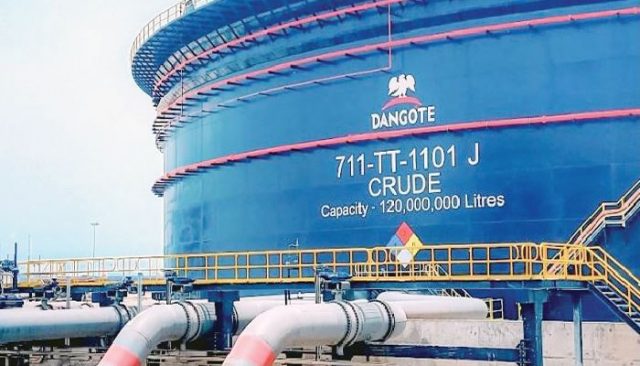
Dangote Refinery Back in Naira: PMS Sales Resume
CHIGOZIE AMADI
Dangote Petroleum Refinery has resumed the sale of Premium Motor Spirit (PMS) in naira, providing a measure of relief to marketers and consumers.
The Gantry price, which is fixed at N1,215/ litre has effectively put an end to a high-stakes, week-long dollar-pricing experiment that threatened to trigger chronic fuel shortages across Nigeria.
According to an official “PMS Price Change Communication” distributed to marketers by the refinery’s commercial operations department, the facility has restarted both its gantry truck loading and coastal delivery channels under the revised local currency pricing model.
However, the relief of returning to naira transactions is heavily balanced by an aggressive price upward adjustment. The ex-depot (gantry) price of petrol has been scaled up from ₦1,075 per litre to ₦1,215 per litre—representing a sharp 13.02% increase. Concurrently, coastal loading prices surged by 11.2%, moving up to ₦1,602,495 per metric tonne. Marketers with pending allocations have been instructed to return all outstanding Authorities to Communicate (ATCs) for immediate repricing.
Independent marketers have expressed measured relief regarding the resolution of transaction modalities, though they acknowledge that consumer prices will inevitably bear the brunt of the adjustment.
Alhaji Abubakar Maigandi, National President of the Independent Petroleum Marketers Association of Nigeria (IPMAN), confirmed the development and noted that the policy reversal will bring much-needed predictability back to downstream logistics, even as operators begin recalculating their margins.
It would be recalled that on July 13, 2026, the 650,000-barrels-per-day mega-refinery surprised the energy market by invalidating all active naira invoices and pegging the price of petrol at $0.779 per litre.
The refinery’s management defended the transition by citing systemic shortfalls in the Federal Government’s highly publicized “Naira-for-Crude” policy.
According to corporate insiders, the volume of refined products sold by the refinery in naira outpaced the actual naira-denominated crude oil allocations received from the Nigerian National Petroleum Company Limited (NNPCL). To bridge the operational deficit, Dangote was forced to procure increasingly higher volumes of crude from international markets (predominantly the United States), creating a severe foreign exchange exposure gap that could only be mitigated by demanding USD from local buyers.
Ostensibly, the transition to a dollarized template severely strained inland product distribution. Marketers, heavily restricted by local foreign exchange access constraints, pulled back on lifting volumes, causing gantry truck loading to grind to a temporary halt.
However the effects was huge on consumers as Private depots rapidly jacked up their cash outtake prices to around ₦1,274 per litre to build up cash cushions against dollar-pegged inventories.
The sudden constraint in fuel supplies instantly manifested in the wider economy, with pump prices crossing ₦1,300 per litre at several retail outlets in commercial hubs like Lagos.
Interestingly ,The swift resolution of the pricing standoff underlines the massive structural leverage the $20 billion Lekki-based facility holds over Nigeria’s macroeconomic stability.
As the nation’s dominant refined product supplier, its commercial templates set the baseline for the country’s broader inflation metrics.
Despite the steep ₦140 hike, current field analytics show that Dangote’s new ex-depot rate of ₦1,215 remains highly competitive against the landed cost of fully imported products.
The return to a naira-denominated frame eliminates the immediate threat of a currency-depreciation spiral directly blowing up the daily pump price of fuel, but consumer costs will remain significantly elevated moving forward.
