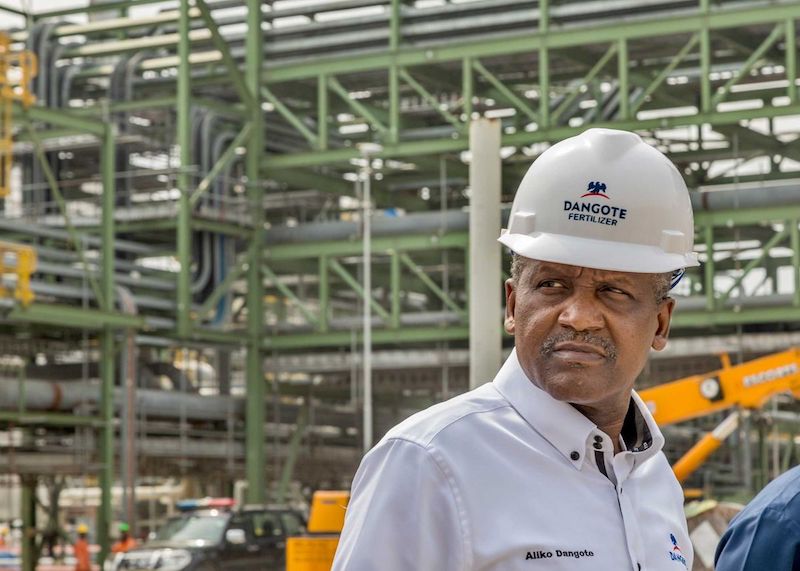
Dangote Breaks Silence on Fuel Costs, Claims Nigeria’s Petrol is Still a Bargain Compared to Neighbours

0
8

. Fingers booming cross-border fuel trade

. Vows to guarantee supply amidst M/East oil crisis

.Says small investors ‘ll be given preference in event of IPO oversubscription


President of Dangote Industries Limited, Aliko Dangote, has attributed the high price of petrol in Nigeria partly to the continued smuggling of the commodity to neighbouring countries where it sells for significantly more.
Dangote said petrol prices in neighbouring countries were between 30 and 50 per cent higher than in Nigeria, arguing that the price difference creates a strong financial incentive for traders to move petrol out of the country.
He stated this in an interview aired on Arise TV on Tuesday while speaking about petrol prices and the availability of the product amid the ongoing crisis in the Middle East.
Explaining why Nigerians may perceive petrol as expensive despite the country producing the commodity domestically, Dangote said the price could not be considered in isolation from the prices in neighbouring countries.
“You know, expensive is relative. In the sense that today, maybe, you know, a lot of them, there’s ignorance also. What they need to do is ask, what is the neighbour’s price?”
He said the continued movement of Nigerian petrol across the borders was partly driven by the significant difference between domestic prices and those obtainable in neighbouring countries.
“I don’t know if you know that there’s still a lot of smuggling of the same petrol we are producing to our neighbouring countries.”
The price gap means that petrol bought in Nigeria can potentially be resold across the border at a substantial premium. Dangote said this creates an incentive for smugglers to divert petrol meant for the Nigerian market rather than sell it domestically.
“Because those neighbouring countries are about 30 to 50 per cent more expensive than Nigeria. So, it’s not actually like for like.”
Dangote specifically cited Niger, where he said petrol was selling at a premium of between 20 and 25 per cent compared with Nigeria.
He used the example to illustrate why the border trade could be financially attractive, particularly when the price difference is large enough to provide an immediate return on the commodity.
“And people can now go and ask, okay, fine, what is the price of, even now at N1,350? Okay, the price in Niger is 20 to 25 per cent more than Nigeria,” he said.
He questioned what other legitimate business could provide such an immediate return.
“So, what business are you going to do that will make you have an instant 25 per cent return?” he asked.
Dangote further explained how petrol intended for domestic distribution could allegedly be diverted towards the border for sale to buyers in neighbouring countries.
“So, it means that, yes, you take the (petrol), you go and take it across the border. You pretend you are taking it to Sokoto, you go and just take it to Ilela, and you sell.
“Actually, they don’t have.”
The implication, according to Dangote, is that a product that should remain available to Nigerian consumers can be moved out of the country because of the higher prices obtainable across the border.
Beyond the issue of price, however, Dangote said the current crisis in the Middle East could pose a different challenge to the Nigerian downstream market.
He warned that the major concern could shift from how much petrol costs to whether sufficient volumes would be available to consumers.
“And the problem now, going forward, I must also warn that this crisis in the Middle East is not even about price; it’s about availability,” Dangote said.
The comment comes against the backdrop of concerns over how developments in the Middle East could affect global energy markets, including the availability and cost of petroleum products.
Asked whether Nigerians should be worried about petrol supplies, Dangote said the Dangote refinery was prepared to continue meeting domestic demand.
“We will deliver to Nigeria. Nigerians don’t need to worry. There will not be any shortage from our own part.
“There won’t be any shortage. There will not be any queues. We will make sure that we keep satisfying the market, despite all odds,” Dangote added.
The remarks came as investors flooded the Nigerian Exchange on Monday following the opening of the initial public offering of Dangote Petroleum Refinery and Petrochemicals.
The N2.15tn IPO was formally opened during the opening gong ceremony at the NGX trading floor in Marina, Lagos, with Dangote sounding the gong to mark the commencement of the offer.
The refinery became the first petroleum refinery to be offered to investors on the Nigerian stock market in the Exchange’s 66-year history.
The IPO comprises 4.1 billion ordinary shares offered at N525 per share, with a minimum subscription of 10 shares valued at N5,250.
The offer is open to retail, institutional and eligible African investors and is scheduled to close on October 13, 2026.
In the meantime, the Nigerian National Petroleum Company Limited (NNPCL) on Tuesday increased the pump price of Premium Motor Spirit (PMS), also know as petrol.
According to a market survey, the majority of NNPCL retail outlets in Abuja and its environs had increased their petrol pump price to between ₦1,395 and ₦1,430 per litre.
This means that the state-owned oil firm adjusted its petrol price upward by between ₦50 and ₦80 per litre..
“The okada man that carried me from bere to Mokola was toasting me” — Lady cries out over rider’s advances
The new prices have been implemented at NNPCL outlets in Airport Junction, Gwarinpa, Kubwa Expressway, Wuse Zone 4 and other parts of the nation’s capital and its environs.
Meanwhile, President and Chief Executive of Dangote Industries Limited, Aliko Dangote,has reaffirmed his commitment to making the ongoing Initial Public Offering (IPO) of Dangote Petroleum Refinery a truly “People’s IPO,” assuring retail and small investors that they will receive priority allocation should the offer become oversubscribedDangote said the offer was deliberately structured to broaden ownership of one of Africa’s most strategic industrial assets and give millions of Nigerians an opportunity to participate directly in the refinery’s growth and future value creation. 

The IPO is designed to deepen financial inclusion and democratise wealth creation by opening ownership to a wider segment of society.

Dangote stated that one of the core objectives of the offer is to build one of the largest shareholder communities in Africa, with a target of attracting not less than 10 million investors from Nigeria and across the continent

Speaking on the public offer, Dangote said: “This is more than a capital-raising exercise. It is a historic opportunity to deepen financial inclusion, democratise wealth creation and enable ordinary Nigerians to become co-owners of a world-class industrial enterprise. From the beginning, our vision has been to create a genuine People’s IPO that allows millions of Nigerians to share directly in the success of this refinery.”

Dangote emphasised that while the Company welcomes participation from all categories of investors, allocation decisions in the event of oversubscription would be guided by the principle of broad-based ownership.

“If the offer is oversubscribed, retail and small investors will receive priority consideration. We are determined to ensure that ordinary Nigerians are not crowded out by large subscriptions. Our objective is not merely to raise capital, but to create millions of shareholders who can participate in the growth and prosperity of the Dangote Refinery. We want as many people as possible to own a stake in this national asset.”

According to him, prioritising retail investors is consistent with his long-held belief that economic development should go hand in hand with widespread citizen participation and ownership.

“We believe prosperity should be shared by the many, not concentrated in the hands of a few. This refinery was built to transform Nigeria’s energy landscape, and we want millions of Nigerians to be part owners of that transformation.”

Dangote further noted that the IPO represents a significant step towards building an ownership economy in which civil servants, artisans, traders, professionals, cooperative societies, pension contributors, young entrepreneurs and Nigerians in the diaspora can participate directly in one of Africa’s most important industrial enterprises.

He added that the offer has been designed to be simple, transparent and technology-driven, with BVN-enabled subscription channels helping to remove traditional barriers that have historically limited participation in the capital market.

Expressing confidence in the success of the offer, Dangote said the IPO would not only deepen Nigeria’s capital market but also stand as a landmark example of inclusive wealth creation.

“Our ambition is clear. We want to build a shareholder base of at least 10 million investors and create one of the most widely owned companies in Africa. That is the essence of the People’s IPO. It reflects our conviction that every Nigerian should have the opportunity to participate in the value being created by this world-class refinery.”

LEAVE A REPLY

Please enter your comment!
Please enter your name here