

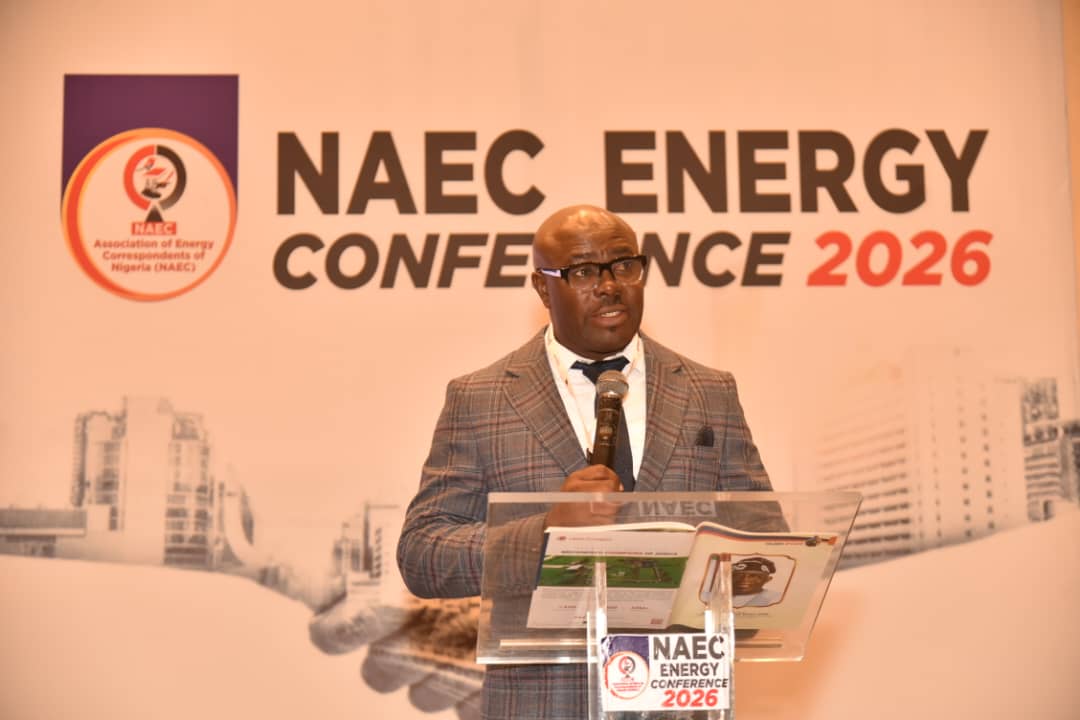
Chairman of the Association of Energy Correspondents of Nigeria [NAEC], Mr. Ugo Amadi, has said that lack of access to assets, finance, infrastructure and credible data remains the core constraint holding back growth in Nigeria’s energy sector
Amadi stated this in his welcome address at the 2026 NAEC Energy Conference organized by the Association of Energy Correspondents of Nigeria [NAEC], held at Eko Hotels & Suites, Victoria Island, Lagos, themed: “Access to Assets: Empowering Players and Driving Growth.
“Welcoming industry leaders, regulators, and stakeholders, Amadi noted that the conference has for over three decades served as an independent platform for solution-driven dialogue to shape policy for the sector.
He said NAEC, which is 39 years this year, has continued to fulfill its nation-building mandate not just by reporting the sector, but by creating a credible platform for honest conversations.
Reviewing developments in the last one year, the NAEC Chairman said the industry has recorded measurable progress across the oil and gas, power and mining value chains, but significant gaps still demand urgent attention
.On oil and gas, he said implementation of the Petroleum Industry Act [PIA] has deepened, leading to new investment inflows, while local refining has gained traction with the Dangote Refinery and modular refineries ramping up, supported by enforcement of the Domestic Crude Supply Obligation [DCSO].
However, he flagged that asset access for indigenous players remains constrained by funding challenges, high entry costs and lengthy approvals, while crude evacuation challenges persist and commercial frameworks for gas-to-power and LPG remain unclear.
For the power sector, Amadi acknowledged gains from the Electricity Act 2023 which has unlocked state electricity markets and private participation, while the Presidential Metering Initiative is closing metering gaps and new investments are strengthening transmission.
Despite this, he said DisCos remain liquidity-constrained with low collection efficiency and persistent estimated billing, grid disturbances continue to expose transmission fragility, and over 90 million Nigerians still lack reliable electricity, forcing reliance on expensive self-generation
On solid minerals, he described reforms under the Mining Roadmap, improved geoscience data efforts and global interest in lithium, gold and bitumen as encouraging, positioning the sector as a diversification pillar.
But he warned that artisanal and illegal mining still dominates the sector, worsened by insecurity in mining zones, poor access to credible geo-data, and lack of processing and beneficiation infrastructure. Access to licenses, finance and equipment for serious local investors, he said, remains a major barrier that forces Nigeria to export raw ore and import finished products.
“It is against this backdrop that we chose this year’s theme: Access to Assets: Empowering Players and Driving Growth,” Amadi said.
“Access is at the heart of Nigeria’s energy challenge. Access to acreage, access to finance, access to infrastructure, access to reliable data, access to power and access to markets. Until we dismantle these barriers, we cannot unlock the growth we seek.
“He said the 2026 conference will interrogate these access questions to chart a new direction and find practical solutions for sustainable growth, expressing optimism that deliberations from the high-calibre panelists assembled will provide actionable takeaways for government and stakeholders
.The NAEC Annual Conference is Nigeria’s longest-running energy media conference and brings together policymakers, regulators, IOCs, indigenous operators, power sector players, miners and financiers.
